
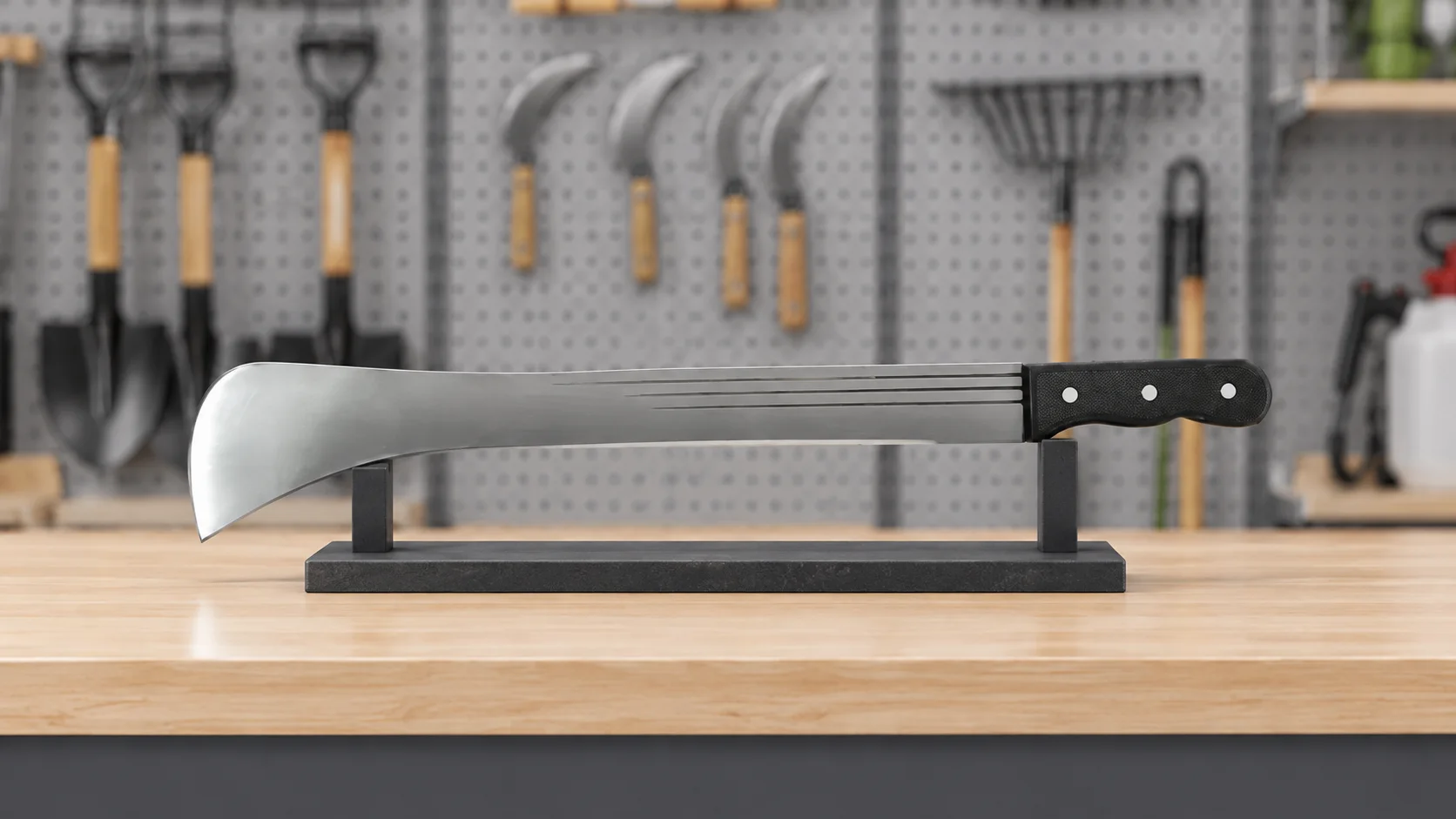
A machete selected for wholesale or retail distribution needs more than a familiar blade shape. The buyer must be able to identify the model, approve the handle and cutting-edge direction, protect the blade in transit, and keep it separate from similar products when several patterns share one shipment. Steel Machete M208 gives importers a specific reference for building that controlled product record.
The Steel Machete M208 product page identifies a carbon steel blade and an M208 profile. The reference image shows a long silver-colored blade that widens and curves at the forward end, together with a short black textured handle secured by three visible rivets. These visible characteristics are useful for model identification, but they do not establish the final length, blade thickness, hardness, finish process, edge preparation, or handle material for an order. Those points should be confirmed with the selected sample.
Use M208 as a distinct assortment line
Many agricultural cutting tools look broadly similar when reduced to a small catalog image. For receiving and repeat orders, “silver machete with black handle” is not a sufficiently controlled description. Keep M208 on its own item line with the model code, product photograph, requested dimensions, approved handle, packing format, destination labeling, and sample status.
The reference silhouette is especially helpful: a relatively narrow main blade extends from the handle and broadens toward a forward-curving end. Three subtle lengthwise lines are visible near the handle side of the blade, and the black grip has three bright rivets. A sample should be checked against the complete outline rather than only the handle color or the number of rivets. Similar details can appear on another machete while the blade profile remains different.
If M208 will sit beside other machetes in the same shop range, give each pattern a clear role. The selection may be organized by the cutting work expected in the target market, familiar regional blade styles, handle preference, retail price position, or pack format. Do not create performance claims from appearance alone. Actual suitability depends on the approved material specification, geometry, handle construction, edge condition, and the way the end user operates and maintains the tool.
Define the blade before requesting comparable quotations
A useful M208 inquiry starts with the full reference image and model code, then states the required overall length or blade length, blade width measurement points, thickness measurement points, surface-finish direction, and cutting-edge requirement. If a dimension is critical, include a drawing that makes the start and end points unambiguous. Suppliers may otherwise measure a curved or widened blade in different ways.
The catalog description identifies carbon steel, but it does not publish a particular grade or hardness on the product page. If these properties matter to your market, request the required grade, heat-treatment direction, test method, tolerance, and supporting documentation before approving a sample. A bright surface should not be described as stainless steel, a specific polish grade, or corrosion-proof unless the final specification supports that claim.
Edge preparation also belongs in the written order. Confirm whether the product is supplied with a market-ready edge, a controlled unfinished edge for local processing, or another agreed condition. The sample approval should show the edge side and the forward tip clearly. Handling instructions and protective packaging must match the supplied edge condition.
Inspect the black three-rivet handle as an assembly
The handle is a prominent identification feature of the pictured M208, but appearance alone cannot confirm its material, internal construction, grip performance, or assembly strength. Ask for views of both handle sides, all three rivets, the blade-to-handle transition, the end profile, and the finished surfaces. Record the approved handle material and texture separately from the photograph.
Check for alignment, visible gaps, sharp projections, loose components, unwanted movement, and surface defects against agreed acceptance criteria. If the buyer requires a pull, impact, torque, or other assembly test, define the procedure and pass criteria before production. Avoid informal claims such as “heavy duty” unless they are supported by a relevant specification and repeatable test.
The earlier Steel Machete M206 buying guide covers a different model with a different handle reference. M206 and M208 can belong in the same purchasing program, but their samples, item codes, carton marks, labels, and inspection photos should remain separate. Similar product names should never be used as evidence that parts or specifications are interchangeable.
Plan blade protection before retail artwork
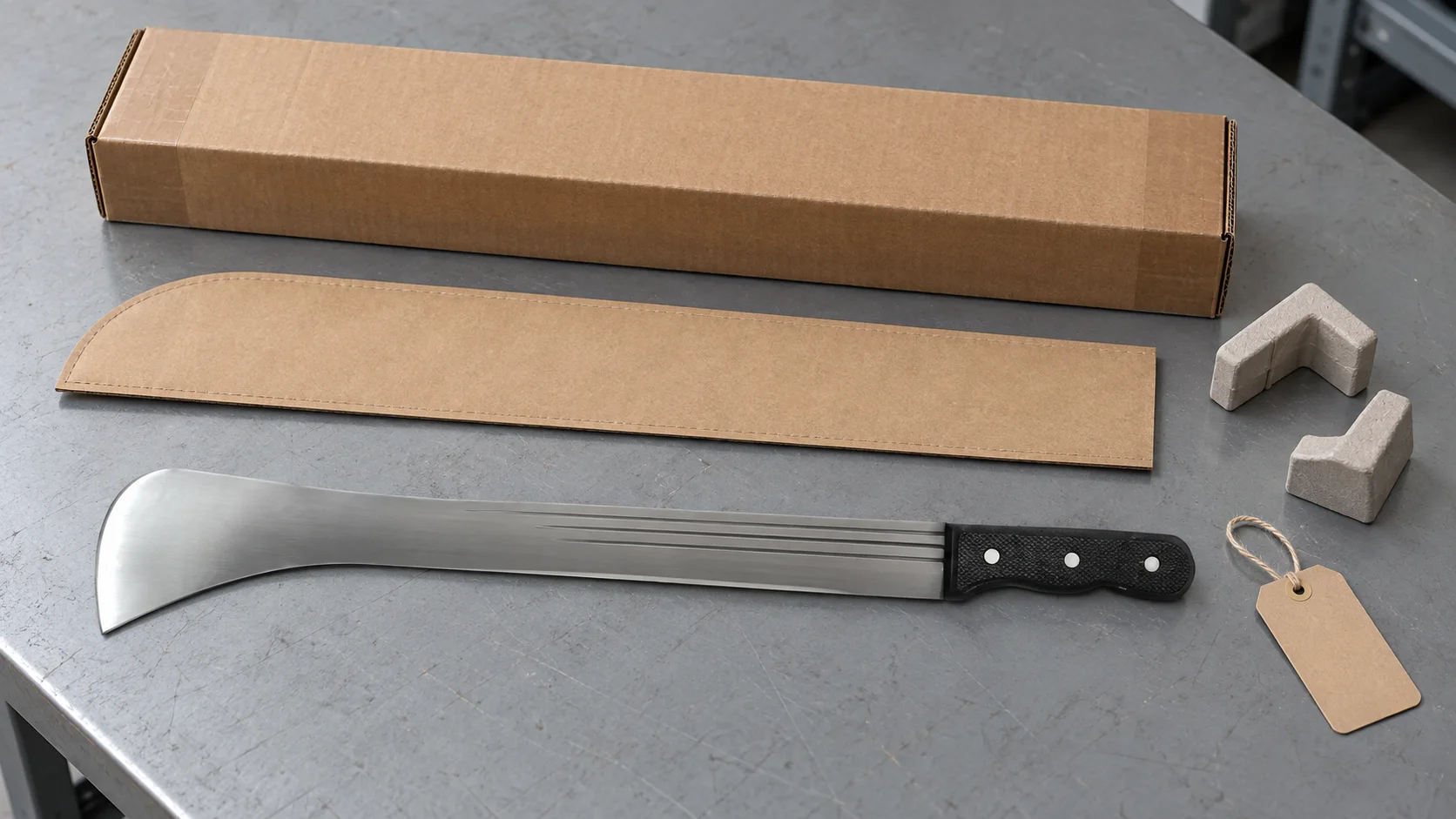
Long cutting tools need packaging that protects handlers as well as product surfaces. Depending on the approved edge and sales channel, buyers can discuss a paper or cardboard blade sleeve, edge guard, individual retail pack, controlled bundle, inner carton, or other protective arrangement. The right choice must be tested with the actual sample; a decorative sleeve that moves freely or leaves the forward tip exposed is not an adequate packing plan.
Confirm how the cover is retained during ordinary carton handling and how warehouse staff can remove it safely. Check that adjacent blades, rivets, and handles do not rub against one another. Where moisture exposure during storage or transit is a concern, agree suitable surface protection and packing materials rather than assuming a silver-colored finish is sufficient.
Keep labels useful without obscuring the product
Retail artwork can include the approved model description, barcode, country-of-origin information, buyer brand, warnings, care information, and other content required for the destination. The exact legal and language requirements should be checked by the importer for the target market. Provide final artwork, color requirements, placement instructions, and barcode data through a controlled approval process.
A hang tag or sleeve should not hide the handle connection or make receiving inspection difficult. If several machete models share a visual design, print a clear model code and scannable identifier on both the individual pack and outer carton. Confirm carton quantity, net and gross weight, carton dimensions, and marks only after the final protective packing has been established.
Build QC photos around the approved M208 record
A practical pre-shipment photo set can include the complete blade silhouette, both blade faces, the widened forward end, cutting-edge side, three-rivet handle views, requested dimension checks, surface appearance, individual protection, inner arrangement, closed carton, carton marks, and packed quantity. Group the photographs by model and carton rather than mixing multiple machetes in one unlabeled folder.
Photo review is a useful coordination step, but it does not replace an agreed inspection method. If the order requires measured sampling, material documents, functional tests, or third-party inspection, define those requirements and acceptance criteria before production. Preserve the approved sample and purchasing record for comparison with future repeat orders.
Combine M208 with a wider agricultural tool order
Buyers can review other patterns in the machete product collection, then add M208 to a broader list of sickles, hoes, shovels, rakes, fasteners, mesh, cutting consumables, or other required hardware. China Tools Supply's mixed-container sourcing service is designed for buyers who do not need one full container of a single product.
Every SKU still needs its own confirmed specification and packing plan. Long blades, handled tools, dense hardware cartons, and delicate packaged goods have different loading considerations. Share the complete list, including products not yet shown in the catalog, so sourcing availability, supplier minimums, packing compatibility, space, weight, and destination requirements can be reviewed together. Consolidation may improve purchasing efficiency, but the result should be calculated for the actual order rather than promised in advance.
Send a focused M208 request
For an M208 proposal, send the model photograph, destination market, expected quantity, required dimensions, edge and finish direction, handle requirement, retail or wholesale packing preference, label needs, and the other products planned for the shipment. China Tools Supply can then clarify which details are available, which need a sample, and how the item can fit into a practical multi-product order.