
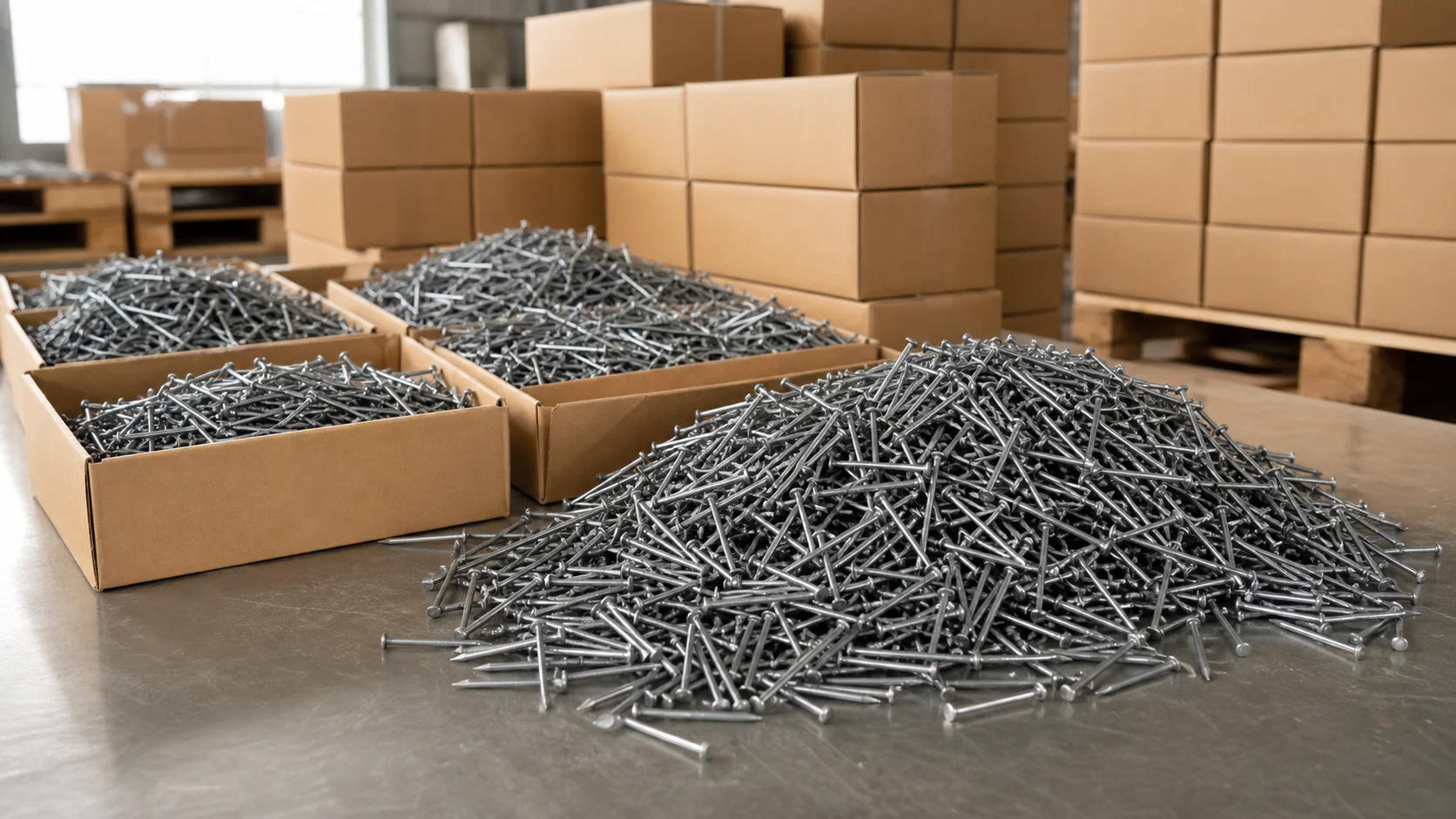
Common iron nails are a basic building-hardware item, but they should not be bought as an undefined “nails” line. The product reference shows bright, straight round-shank nails with small round flat heads and sharp points. For hardware importers, that simple form still needs a clear agreement on length, shank diameter, head profile, point appearance, finish direction, inner packing, carton weight, and carton marks. Those details determine whether the buyer receives the correct bulk product for its own building-material, wholesale, or replenishment program.
The Common Iron Nails with Bulk Packing page is the starting point for this product line. The item is positioned for building-material buyers and bulk carton supply. Buyers should use the product image to identify the straight bright common-nail style, then supply the requested size range, quantities by size, target market, finish requirement, inner packing preference, and outer-carton requirement. A quotation based only on total nail weight can leave too much of the actual product undefined.
Why common nails need their own specification line
Common iron nails, concrete nails, roofing nails, coil nails, and other fasteners may share a catalog category, but they do not have the same product profile or packing discussion. The common nails shown in the reference have straight smooth shanks, round flat heads, and pointed tips. They should not be confused with wide umbrella-head roofing nails, collated coil nails, twisted shanks, screws, or construction nails intended for a different application. Keeping the product line clear makes it easier to compare quotes and to prepare receiving instructions.
For every requested size, create a separate item line. Record the length, shank diameter, head reference, point reference, finish direction, quantity, inner packing, carton quantity, and destination marks. This approach helps a buyer avoid receiving several mixed sizes under one broad carton description. It also gives the distributor a clean reference for later stock replenishment when one common-nail size moves faster than another.
Start with length and wire diameter
Length and shank diameter are central to a common-nail inquiry. They affect the product's intended use, the amount of material in each piece, the approximate quantity represented by a packing weight, and the way a buyer separates sizes for resale. Do not assume that one familiar market name corresponds to the same measurements in every destination. State the requested dimensions and the unit of measurement in the inquiry, then keep each size distinct through sample approval, packing, and carton marking.
It is useful to ask for an agreed measurement method. A product photo with a ruler can show the length reference, while a caliper can help document the selected shank or head measurement. These checks should be tied to the buyer's approved size requirement, not used as a replacement for a formal specification where one is needed. Clear size references are especially important when an order contains several close dimensions that look similar once packed in bulk.
Confirm head, point, and finish from the sample
The head and point are visible features that help identify a common nail. The reference product has a small round flat head and a sharp pointed end. During sample review, compare the selected head form, straightness, point appearance, and surface presentation with the approved reference. If the buyer has a finish requirement, it should be stated clearly. The bright metallic appearance in the image is a visual reference, but the final order should follow the agreed finish direction rather than an assumption based on one catalog photo.
A small sample file can prevent many later questions. It can include a photo of the selected nail, the size reference, a close view of the head and point, the agreed packing format, and any carton mark. If the buyer needs several sizes, keep a separate sample label or reference entry for each size. This makes it much easier to compare the goods at pre-shipment stage and after arrival.
Choose bulk packing around the buyer's receiving process
Bulk packing is not one fixed format. Some buyers need loose nails in an agreed inner bag or inner box before placing them into outer cartons. Others may use a different bulk arrangement for warehouse replenishment. The suitable choice depends on the buyer's own handling, stock counting, resale method, desired carton weight, and destination conditions. It should be discussed before the quotation is finalized because the same nail size can be packed and handled differently for different channels.
Ask the buyer to identify whether the goods will move directly to a distributor, be divided into smaller packs after arrival, or be sold through a hardware counter. That information helps define the useful inner-packing format. It also makes it possible to plan carton strength, moisture protection where required, unit count or net-weight record, and outer carton marks in a way that the receiving team can actually use.
Use carton marks to keep nail sizes separate
When a purchase includes more than one nail size, carton identification matters as much as the product itself. The outer carton should make it possible to distinguish the nail type, selected size, packing quantity or weight, and buyer's agreed marks without opening every carton. A vague mark such as “iron nails” does not help a warehouse separate close specifications. Clear marks support faster receiving, inventory allocation, and later reorder decisions.
Carton planning should also consider handling weight and loading sequence. Nails are compact and can create dense cartons, so carton dimensions and gross weight should be reviewed with the actual packing plan. The correct arrangement depends on the selected sizes, packing method, transport route, and destination handling. It is better to confirm the exact carton program than to apply an arbitrary carton weight to every common-nail order.
QC photos should show the specified item and packing
A useful pre-shipment photo set can document one approved sample from each size, a length reference, a shank or head check where requested, point appearance, inner packing, outer carton, and carton marks. The purpose is not to produce random warehouse images; it is to let the buyer compare the actual shipment with the agreed nail specification and packing plan. Group the photos by size when multiple dimensions are shipped together.
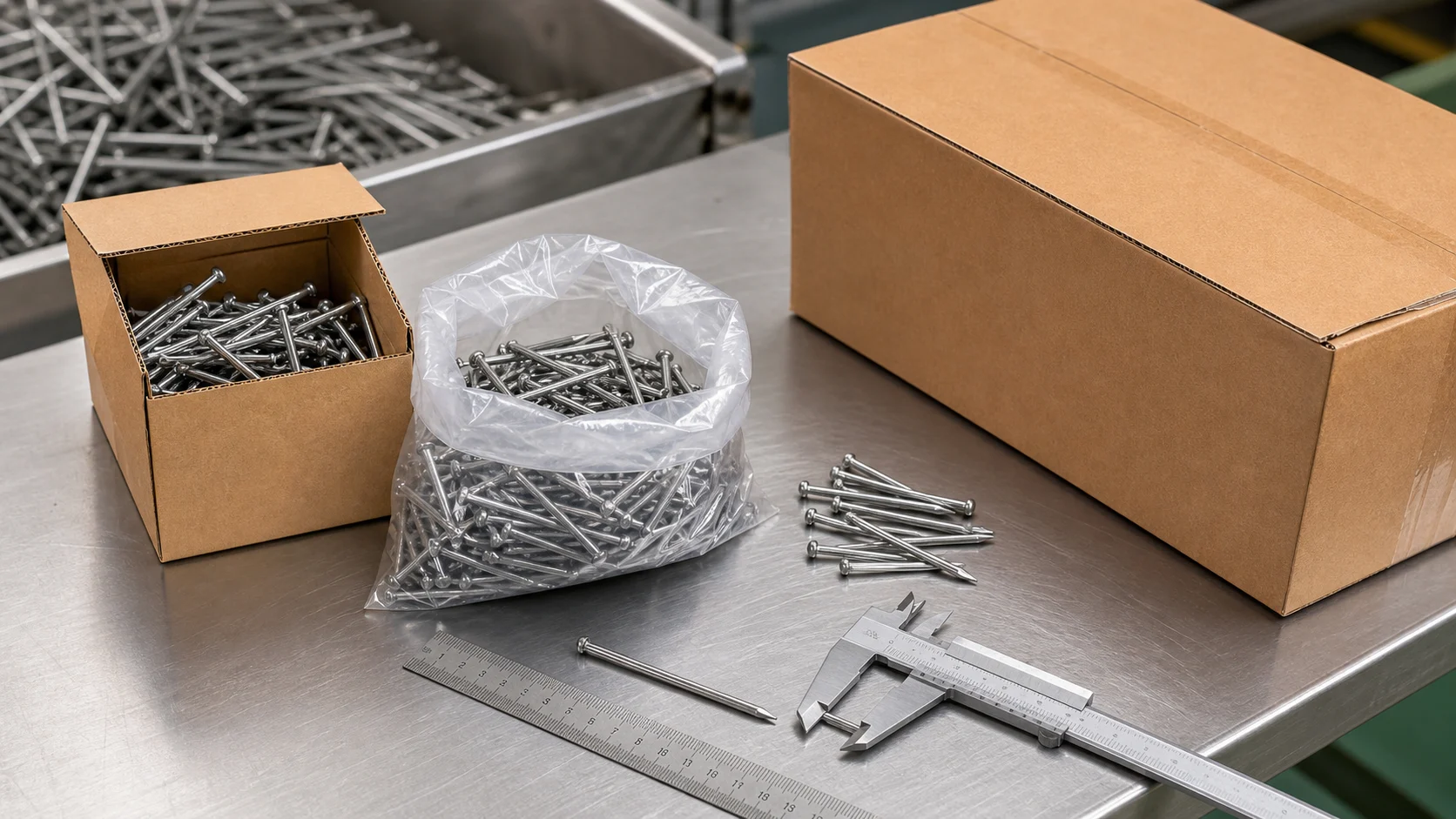
For common nails, the review list should stay focused: correct size reference, straight shank, agreed head and point appearance, finish direction, inner packing, carton identification, and packing condition. If the buyer needs a particular net weight or count convention, state it before packing begins. A clear checklist is more useful than relying on a product name that could cover several different nail sizes.
Keep common nails separate from specialized fasteners
The broader Nails & Fasteners category is useful for buyers who also source concrete nails, roofing nails, coil nails, or related products. Each line should nevertheless keep a separate specification and packing record. A common nail is not interchangeable with a roofing nail merely because both are sold in building-material channels. Different head styles, shank forms, finishes, sales formats, and end uses require different purchase references.
The existing iron nails and fasteners buying checklist provides a wider comparison framework for a mixed fastener list. This product guide goes further into the practical bulk-packing decisions for straight common nails: grouping sizes correctly, agreeing inner packing, identifying cartons, and retaining a consistent sample record for repeat shipments.
Include common nails in a wider hardware purchase
Common iron nails do not need to be sourced as a stand-alone container. They can be combined with compatible building hardware, wire products, garden tools, agricultural tools, or other approved items when each SKU has its own packing and carton data. The mixed-container hardware service helps buyers assemble a practical purchase program while keeping individual products separately specified.
For a Common Iron Nails with Bulk Packing quotation, send the selected sizes, requested dimensions, quantities by size, finish direction, inner packing requirement, carton preference, carton marks, destination market, and any other items planned for the order. With that information, China Tools Supply can organize a focused sample discussion, bulk-packing review, QC photo list, and export plan based on the buyer's actual receiving requirements.